
Kev Rowley 2024
I was recently contacted by Alan Rowlands who looks after the recording on the Island of Lundy as he had found Ranatra linearis there this year as further proof of it’s range expansion in the UK. In addition he had photographs of both adults and juveniles of Ilyocoris cimicoides (Saucer Bug) there as new additions. Lundy is 11 miles off shore and it would take a great intent to fly there and then breed that I thought I would look to see if it is also extending it’s range.

The first map I have is Thomas Huxleys 2003 Atlas where it is firmly in the East, South and Midlands but a smaller number of records across to the coast in Wales, the same through Devon and Somerset but no records for Northumberland, Lake District and Lancashire. As part of the text in this he said that it was extending it’s range at that time.

Tony Cook then produced an on-line Atlas in 2015 at aquaticbugs.com that clearly shows that more records have filled out the East, South and Midlands but also Cheshire, Shropshire and into Devon. The most Northern record is from Newcastle upon Tyne
Roll forward to 2024 and I have created this current map where I have combined all the records from NBN atlas.com and iRecord.org.uk using OSGM in QGIS.
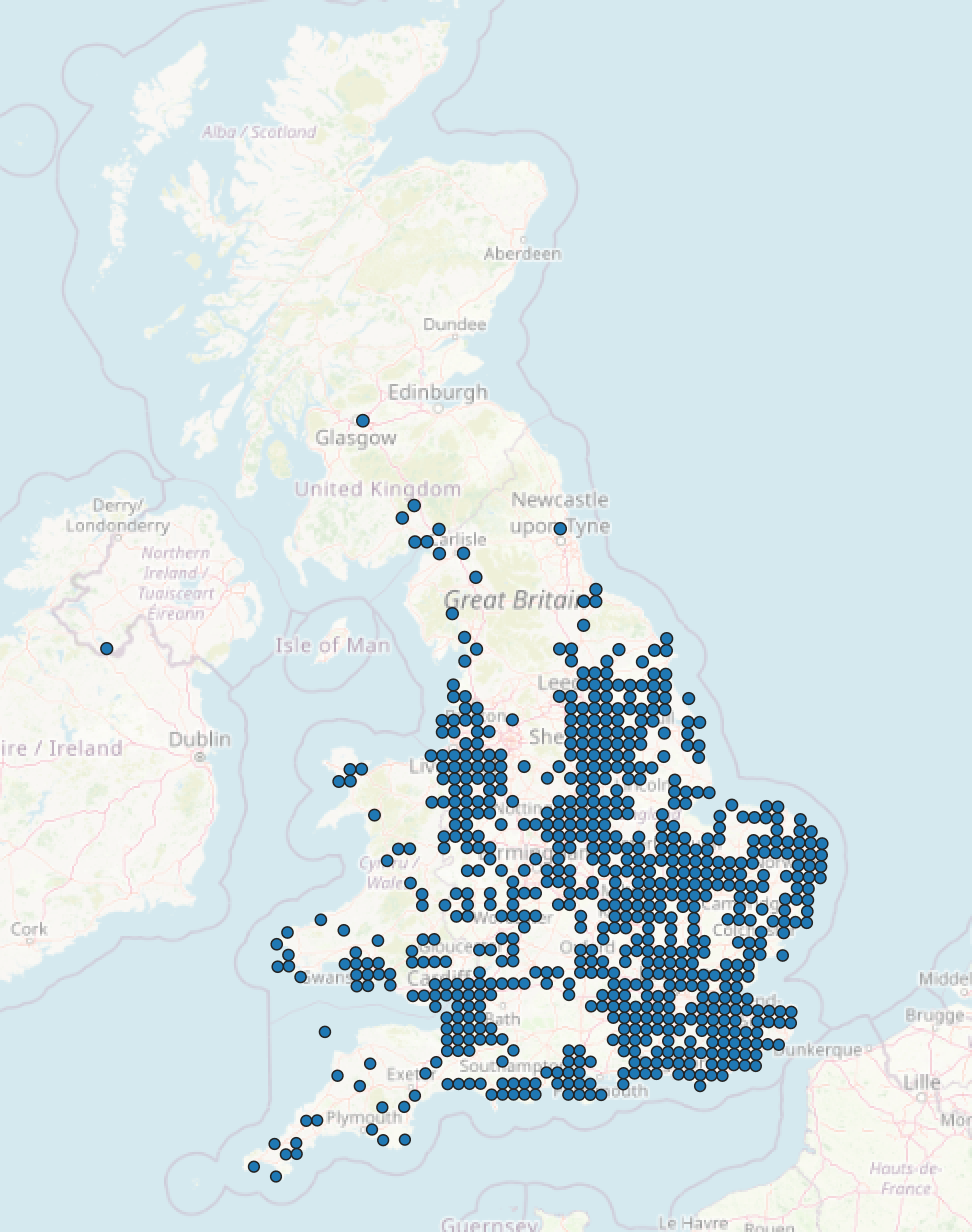
Once again the records have filled out in the East, South, Midlands and Cheshire. There are also a few more records into Devon and Cornwall as well as the Lundy record. It has also expanded westwards into Wales with a good number of records now in Anglesey. It has really pushed on Northwards with records around Carlisle and Cumbria from Steve Routledge and Ryan Clarke, and into the Scottish borders with records from Rob Merritt.
However the most Northern records are from the River Clyde in Glasgow from records in the Glasgow Museums BRC from 1890 and 1901. So maybe it is just regaining it’s range.
My expectation though is that it will continue to move up into Glasgow again and then into the Eastern areas of Scotland and possibly also expand around Northern Ireland after Stuart Warrington’s specimen in 2020.
The saucer bug can be found in almost any water body amongst dense vegetation, but as it migrates (Petak, Ester et all) found it prefers open habitats, rich in submerged vegetation, without submerged terrestrial materials as part of their studies on their movement.
Not only do they walk/crawl between water bodies at night to disperse as has been seen numerous times but some can also fly as experienced by Johnty Denton (Denton & Rodram 1998) and also again in 2005 (Het News 2005). It appears that while they have wings under the Hemelytra the wing muscles are not fully formed. However in a small number these muscles do develop to allow some to fly ( Larson, 1970). Maybe they can also swim too, there was a report by Adrian Chalkley ( Het News 2005) of a Ranatra linearis swimming happily in saltwater at Wells. Maybe if they can’t fly all the way then it also can swim for a short time in saltwater too.
It would appear that if the urge to disperse is strong enough and the weather takes a part in this, that they will fly to new ponds over obviously quite large distances if needed.
References
Peták, Eszter et al. “Habitat use and movement activity of two common predatory water bug species, Nepa cinerea L., 1758 and Ilyocoris cimicoides (L., 1758) (Hemiptera: Nepomorpha): field and laboratory observations.” Aquatic Insects 36 (2014): 231 – 243.
Denton, Jonty and Rordam, Christian. 1998. “Observations of Ilyocoris cimicoides (L.) (Hemiptera: Naucoridae) in flight.” British journal of entomology and natural history 10, 225–225.
Larson, Ossian. 1970. “The flight organs of Ilyocoris cimicoides L. (Hem., Naucoridae). Ent. Scand 1. 227-235.
Huxley, T. 2003, Provisional atlas of the British aquatic bugs (Hemiptera, Heteroptera) Huntingdon: BRC.
 Aquatic Bugs